
Sagar Informatics Pvt. Ltd. delivers a structured Supply Chain Automation System through Logistics Mitra, an enterprise-ready Logistics Management Softwarebuilt for multi-branch logistics companies operating across India.
Our automation-driven platform centralizes pickup, dispatch, delivery, billing, COD, and compliance workflows - reducing manual effort, improving cost control, accelerating TAT, and enhancing operational accuracy across the entire logistics network.
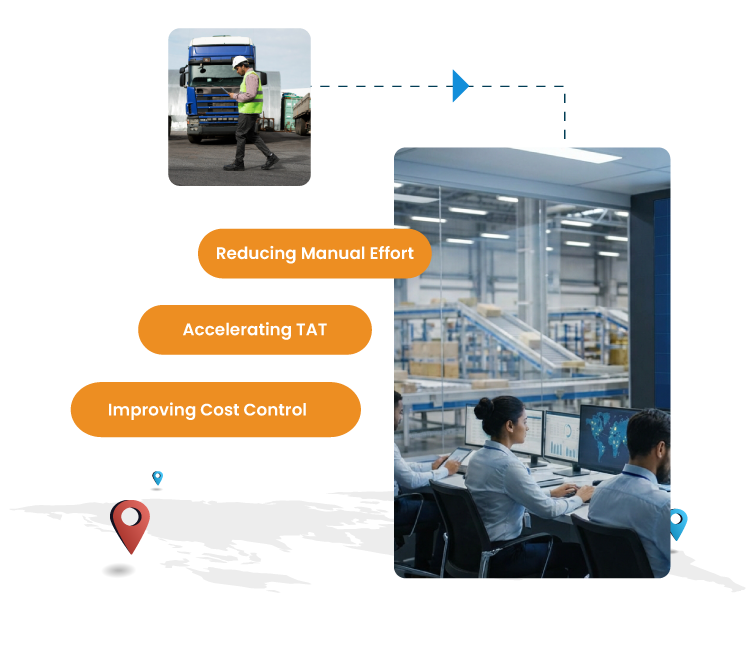
Supply Chain Automation System refers to a centralized digital platform that automates core logistics workflows from order intake to final delivery and settlement.
It replaces spreadsheets, phone calls, and disconnected tools by creating a structured data flow between pickup teams, hubs, dispatch units, delivery staff, billing departments, and management.
With a single workflow engine and unified database, automation eliminates data silos, improves coordination across branches, and ensures faster, more accurate logistics operations.
 Automated pickup scheduling and shipment booking
Standardized LR/AWB documentation workflows
Dispatch planning and route-based vehicle allocation
Real-time shipment tracking and delivery confirmation
Automated billing, COD reconciliation, and GST compliance
Centralized operational visibility across branches
Automated pickup scheduling and shipment booking
Standardized LR/AWB documentation workflows
Dispatch planning and route-based vehicle allocation
Real-time shipment tracking and delivery confirmation
Automated billing, COD reconciliation, and GST compliance
Centralized operational visibility across branches
Our Logistics Mitra Supply Chain Automation System helps logistics companies streamline workflows, reduce manual effort, improve operational accuracy, and scale operations efficiently.
As logistics networks grow, manual processes create operational risks such as:
Without automation, scaling operations becomes inefficient and costly.
Logistics Mitra standardizes and automates logistics workflows — ensuring consistent execution across branches and teams. It also supports complex multi-client logistics environments through integrated 3PL Management Software capabilities.
SIPL’s LMS system automates logistics operations across every stage of the supply chain.
Pickup scheduling, shipment booking, and documentation are captured through structured workflows, reducing manual errors at the initial stage.
LR/AWB generation ensures clean, consistent data across branches, enabling smooth downstream dispatch and billing processes.
The system supports dispatch planning for both PTL consolidation shipments and FTL vehicle allocation through integrated transport management workflows.
Live status updates, OTP-based verification, and digital POD capture ensure accurate and timely delivery confirmation.
Invoices are generated automatically based on predefined rate rules to ensure billing accuracy. COD reconciliation, GST-compliant invoicing, and E-Way Bill management are handled within the system to reduce financial and compliance risks.
Automation enables real-time dashboards and MIS reports that track shipment volume, TAT performance, branch efficiency, and billing status.
Logistics Mitra follows a structured automation-first sequence:
Shipment details are validated and recorded digitally to ensure accurate downstream processing.
Standardized LR/AWB creation ensures clean data flow across branches and teams.
Manifests and route allocations are generated using structured workflows to reduce coordination gaps.
Live tracking and delivery verification ensure transparency and accurate shipment closure.
Invoices, COD reconciliation, and compliance documentation are processed automatically based on configured rules.
Dashboards and reports provide insights that help management identify bottlenecks and improve efficiency.
With 19+ years of logistics software expertise, Sagar Informatics builds automation-driven systems aligned with Indian logistics workflows.
We help logistics companies transform manual supply chains into structured, automated, and future-ready operations.
IT company offering a suite of software & mobile application development services across various industry verticals. We facilitate the development of an innovation culture. With our breakthrough solutions, businesses can challenge the limits and gain a competitive advantage.

 Head Office